
The previous post tackled the Smerinthinae, a subfamily of the Sphingidae. This post looks at another: the Sphinginae. There are 9 species reported here in BC, though Agrius cingulata and Lapara bombycoides are unlikely to be seen – see below. I’ve only seen 4 species at this point, so this post will have a few gaps.
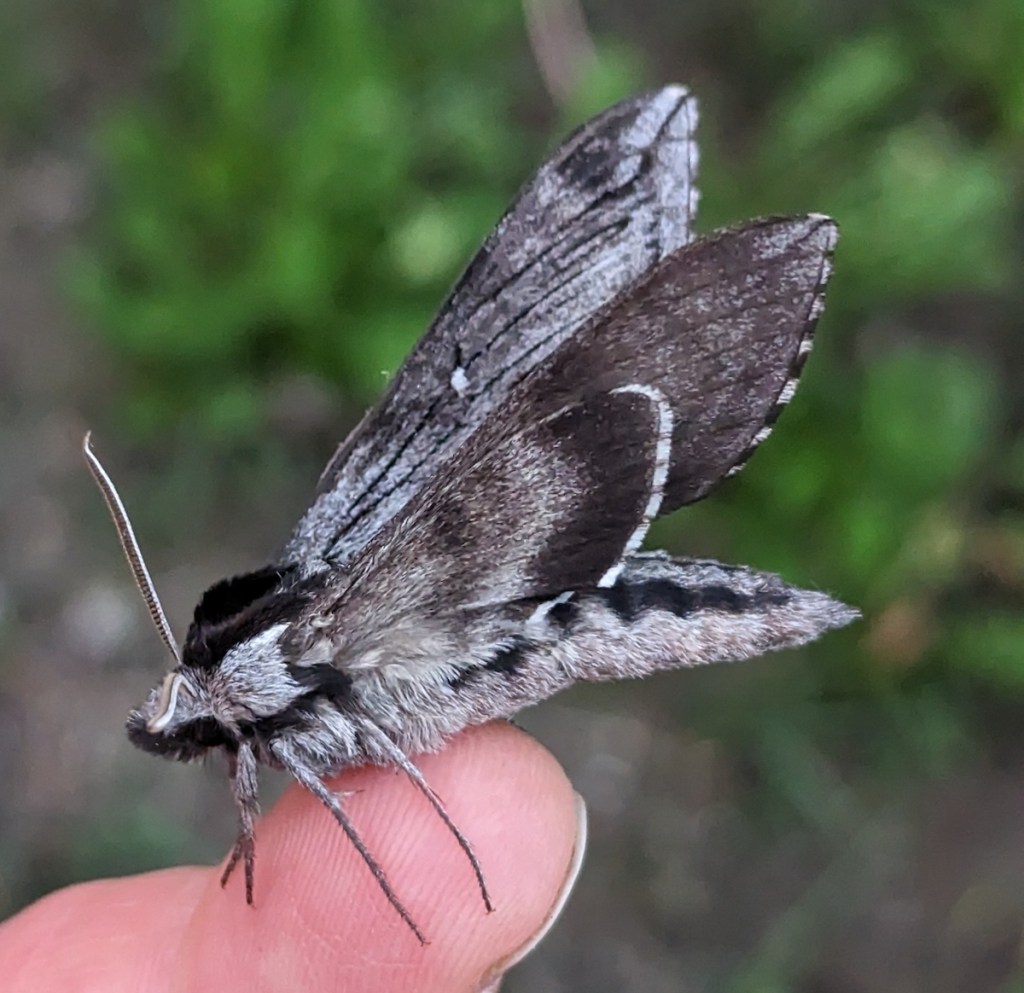
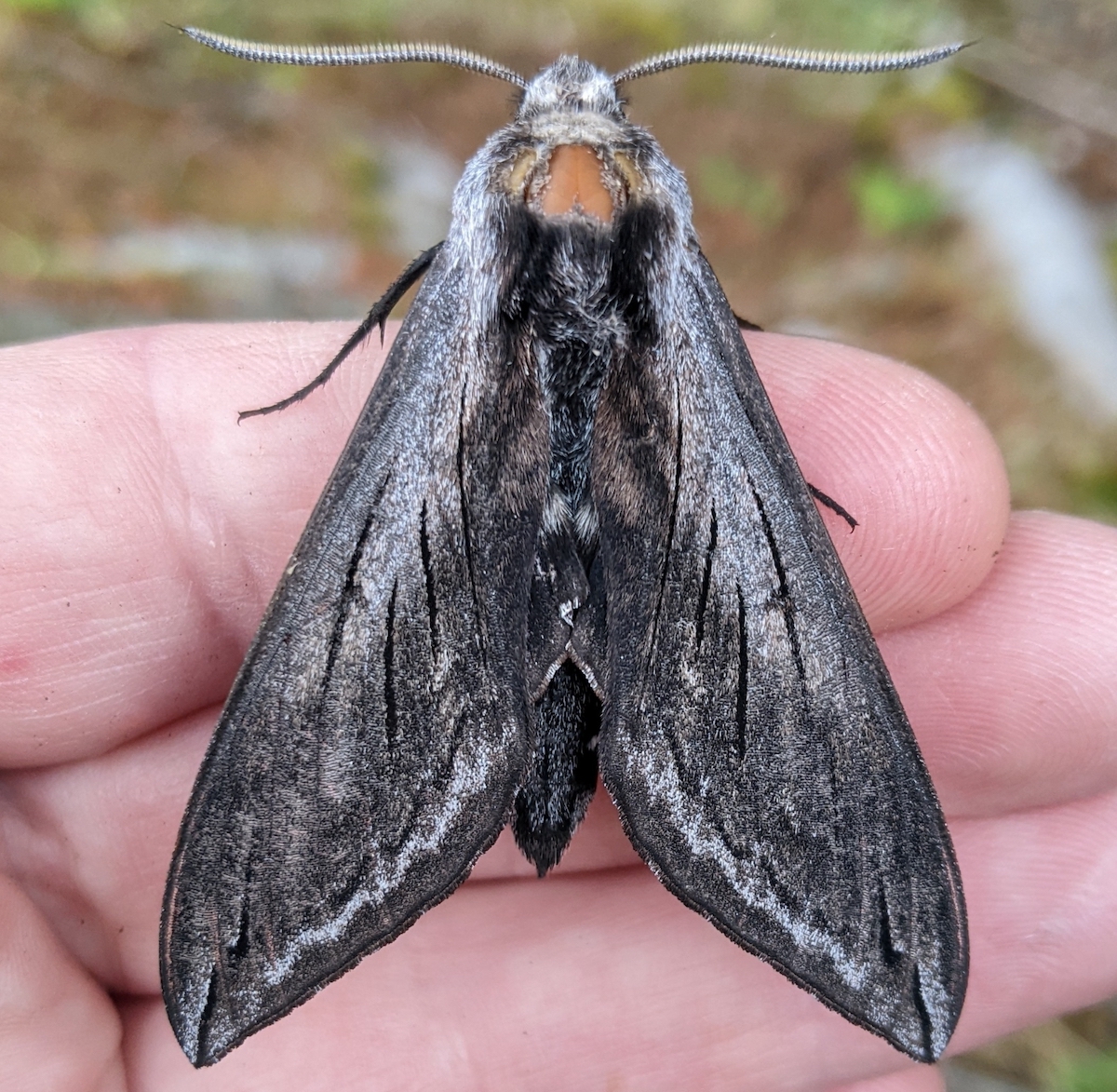

As you can see from the photos – the group are typically ashy coloured with sub
Agrius cingulata (pink-spotted hawk moth)
(40-58mm) This is a very rare vagrant that breeds in South America, Central America and the southern US states. There are only a handful of sightings in the Pacific Northwest, the most recent being in Oregon, Oct 2023. It’s a very distinctive moth with bright pink bands on the abdomen and bold pink on the hindwings. Not something you’d mistake.
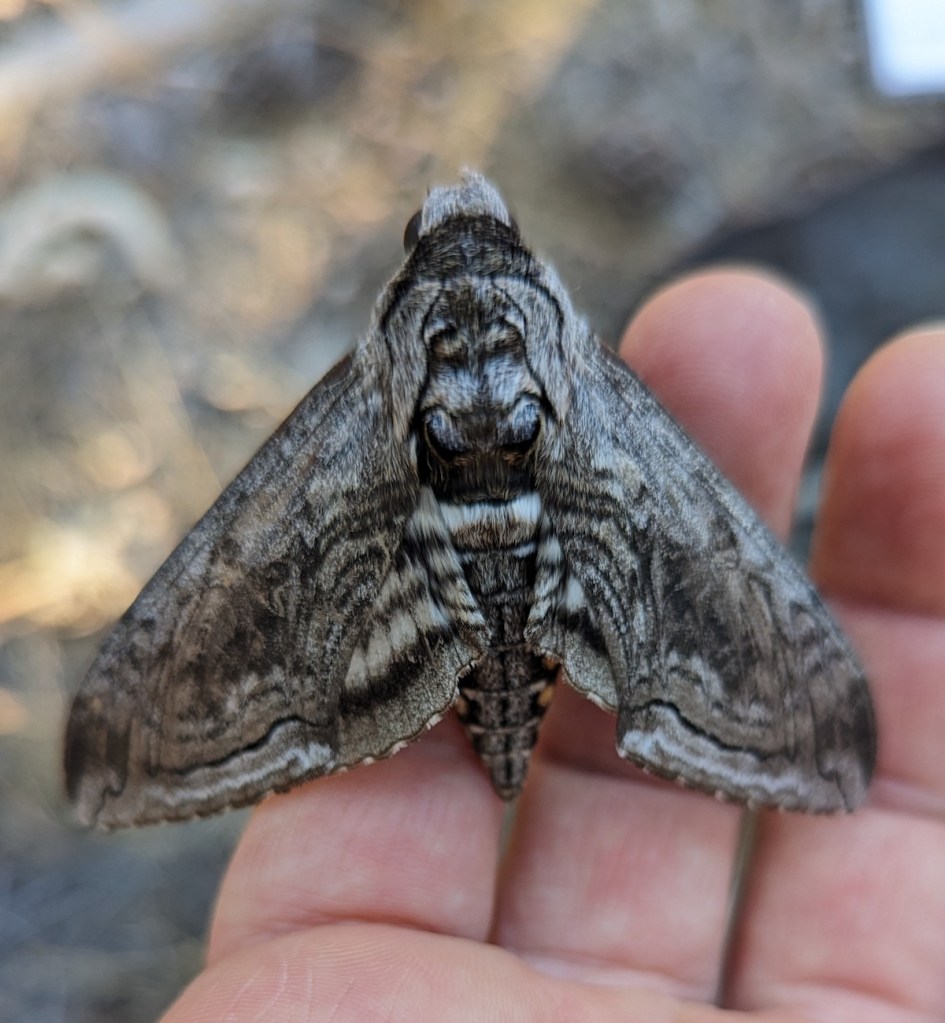
Manduca quinquemaculata (Five-spotted hawk moth)
(52-57mm) See image above. This was one of the highlights of my last year’s mothing. I encountered one after a night of mothing in Oliver. The picture above is awful, I knoew – I have a memory of desperately wanting to go to the washroom, so took some quick blurry shots and shot out of there. Doh. Intriguing-looking sphinx moth; very unique markings and subtle colourations.
Sphinx chersis (Great Ash moth)
(53-58mm) The largest of the moths in the genus with observations reported around Portland to the south and in Calgary to the east. No BC observations listed on iNat or PNW moths. MPG lists a single one, which probably doesn’t have any location associated with it.
Sphinx vashti (Vashti sphinx)
(32-37mm) The most common of the genus spotted in the province. Very variable moth. I’ve confused this with S. perelegans in the past, but the subterminal line is a nice differentiator: it’s smooth and more pronounced in S. vashti; S. perelegans is weaker and a little more jagged.
Sphinx perelegans (Elegant sphinx)
(43-50mm) The only species of Sphinginae I’ve seen here on Bowen Island – I believe it’s the only one in the region. Small, dark grey discal spot.
Sphinx poecila (Northern apple sphinx)
(32-40mm) One of the rarer Sphinx species here in BC. I’ve been lucky enough to see two specimens over the last 3 years, both up in Prince George at the same location. It’s similar to the other Sphinx spp. but the small white discal spot is an easy identifying marker. Kinda surprised by the reported size – I recall them being larger. Next one I see I’ll measure.
Sphinx luscitiosa (Clemen’s sphinx)
(males 22–26mm, females 31–37mm) The 2015 checklist lists this species without the “U” for unconfirmed but I haven’t read of any known sightings in the province. Possibly it’s so likely to be here, it’s not even regarded as tentative. Not sure. But I’ll certainly be keeping an eye out when I head to the Kootenays this year. It’s a neat looking moth. The forewing markings remind me something in the Pheosia genus, Notodontidae. Hindwing is distinctly yellow. Quite sexually dimorphic as the sizes above show.
Sphinx drupiferarum (Wild cherry sphinx)
(44-54mm) Still haven’t seen this blighter! Pretty common in BC;
The discal spot is signified by a short, thin, transverse black line.
Lapara bombycoides (Northern pine sphinx)
(45-60mm) The 2015 checklist says it could appear in the NE boreal forests, but all the range maps I’ve seen place it squarely in the East. Very few sightings west of Ontario. Not even listed on PNW moths.
 BC Moths