
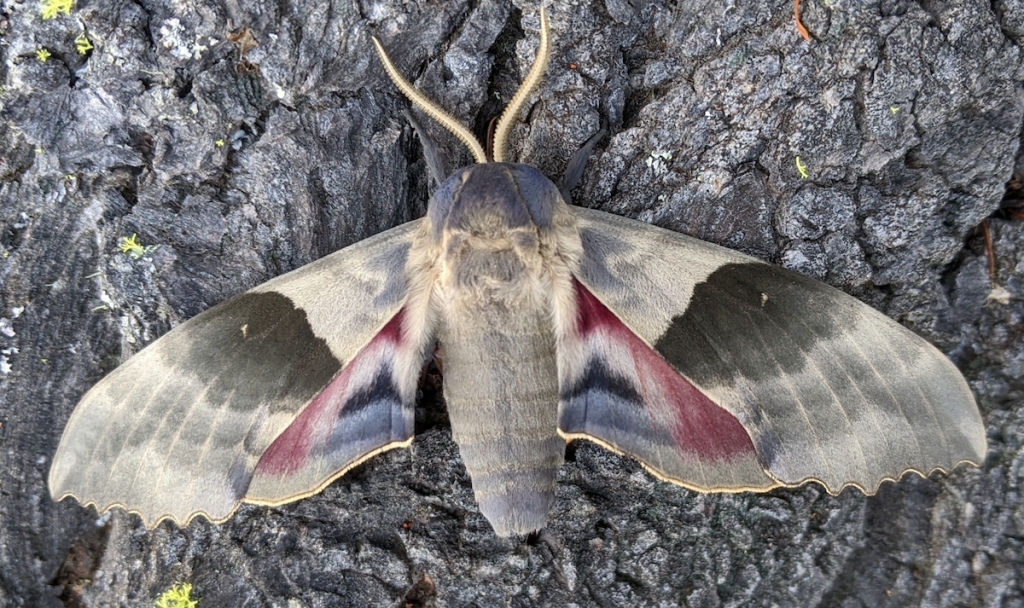
Let’s take a look at a subfamily of the Sphingidae (sphinx moths), the Smerinthinae. There are 6 species in the province, but iNat has a tantalizing 7th that was reported, incongruously out of range, somewhere in the Cariboo. Assuming the identification is correct it’s probably safe to say it arrived via anthropocentric means. But the species isn’t wholly unrealistic for BC: PNW shows their range extends into the Okanogan, more northerly than Seattle. So for people in the southern Okanagan, keep your eyes pealed.
Let’s look at the ones we know are here. I’ve seen all 6 of these species with some frequency; by and large they’re easy IDs but I’ll talk about a couple of the Smerinthus spp.1 below.


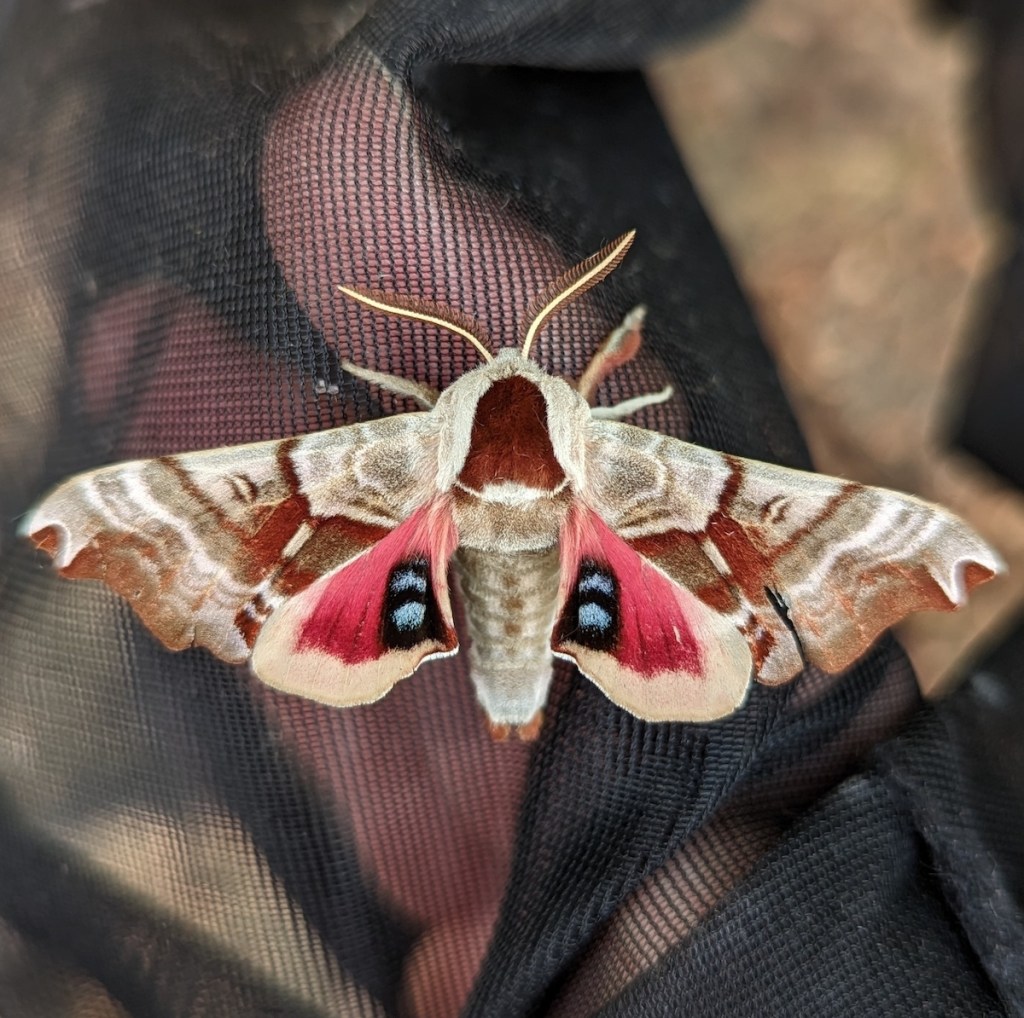
Paonius myops (Small-eyed sphinx)
Attractive, bright brown-orange sphinx moth that flies May-Aug, ranging in size from 25-30mm. They’re a little similar to their sister species, P. excaecata but I don’t think I’ve ever mistaken one for the other. The colouration can do a number on your retinas. The head/thorax has some distinctive lines which aren’t found on P. excaecata – and there are many other differentiating marks – like I said, they’re pretty different. You stop noticing all the individual variations when there are so many. When the wings are folded in rest for this genus, the bulge of the hindwing noticeably projects out beyond the costa of the forewing creating a curious outline, as shown in the photos above.
Paonius excaecata (Blinded sphinx)
Larger than P. myops (28-39mm) and browner, much less orange. Unlike P. myops, these are found in the lower mainland and Bowen Island.
Pachysphinx modesta (Modest sphinx)
I love these guys. Large and impressive with an attractive subtle red/purple flush on the hindwing – see the main image on this post. Cool, hey. These struck me as somehow more primitive than the other hawk moth: plainer, bigger, less ornamentation – almost like they were drawn by a child. Like P. myops above, they’re found east of the Cascades. I’ve seen them around Cache Creek and Merritt. Great bloody moth.
Smerinthus spp.
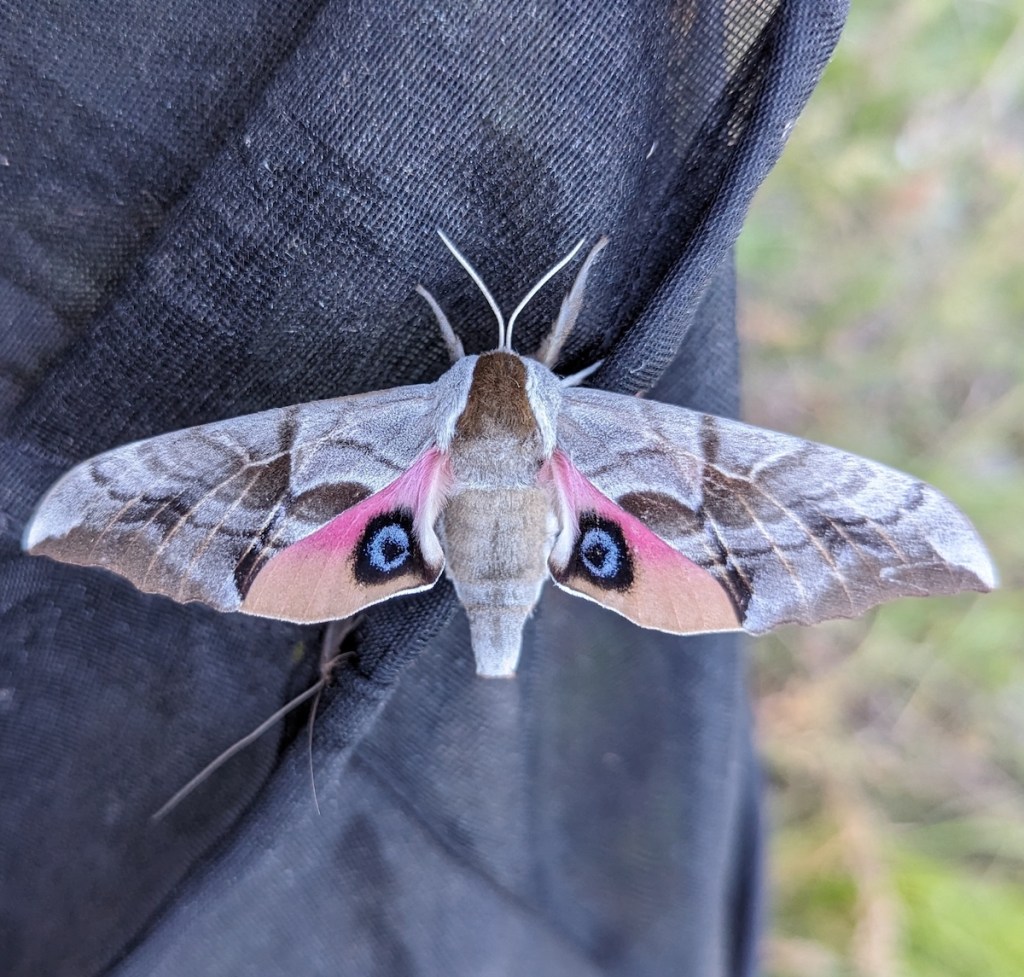
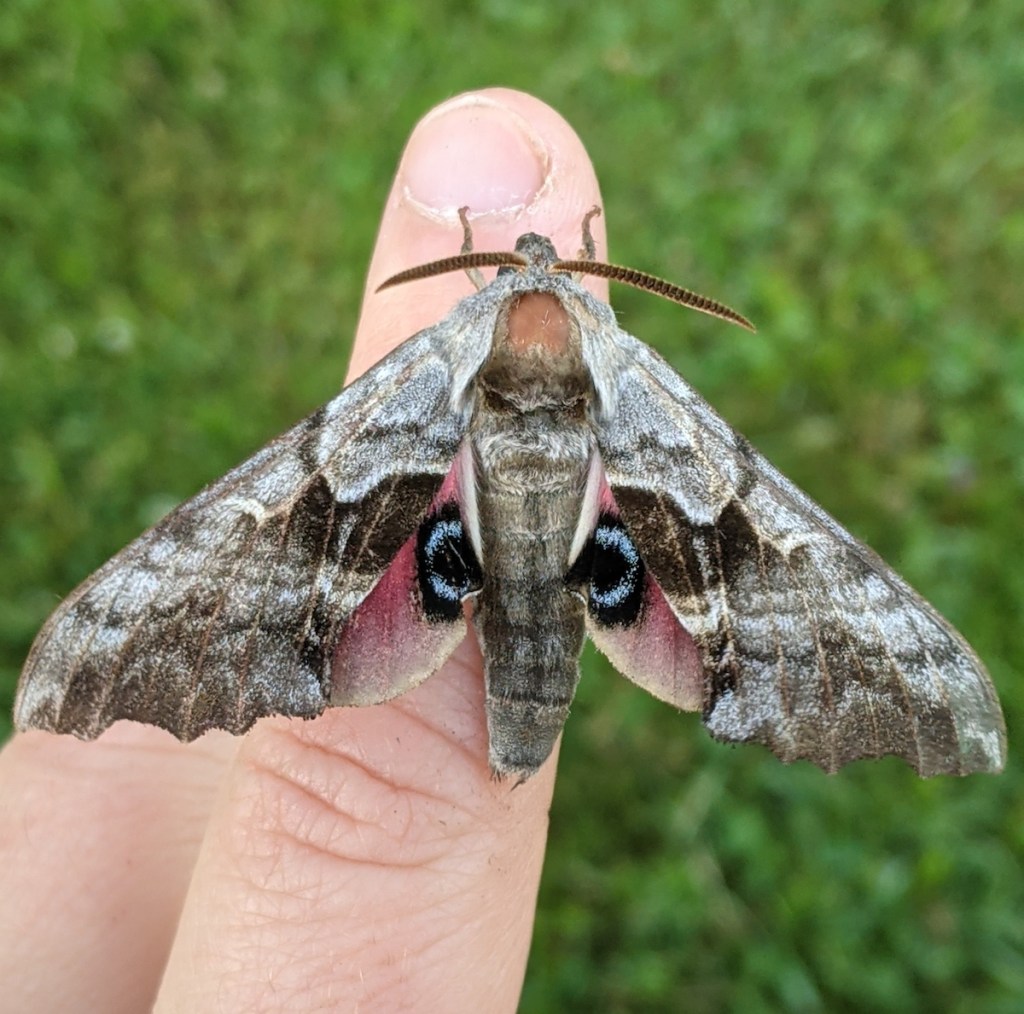
The Smerinthus are known as the “eyed hawkmoths”, with pronounced eyespots on the hindwings. To be open about it, at this stage I’m not that comfortable telling apart S. opthalmica and S. cerisyi, but iNat’s algorithm is typically pretty confident and repeatedly confirmed by other naturalists on the site – so I’ve been leaning on that little too much, instead of researching and memorizing the differences. This year I’ll be doing my homework.
S. jamaicensis (Twin-spotted sphinx moth)
The common name says it all: very different spots on the hindwing, which makes this moth easy to distinguish from the other Smerinthus species. The image above shows it pretty clearly. But if you can’t see the hindwing, the forewing has a noticeably discal spot (basically like the reniform spot, on noctuids), incomplete at both ends. This is where I wish Photoshop was affordable, because I’d like to knock up an image to better show it… But look at the picture above and compare it against the other two Smerinthus. The discal spot is quite visible centred between the postmedial and antemedial lines. This isn’t a feature on either of the other Smerinthus species in the Pacific Northwest.
S. opthalmica (Western eyed sphinx moth)
The more southern of the two remaining Smerinthus species. For identification vs. S. cerisyi, check out the following PNW page. When I”m more comfortable differentiating these two I’ll update this post and chime in with my own remarks.
S. cerisyi (One-eyed sphinx moth)
Found east of the Cascades and up into northern BC.
- “spp.” is shorthand for species, plural. ↩︎
 BC Moths