
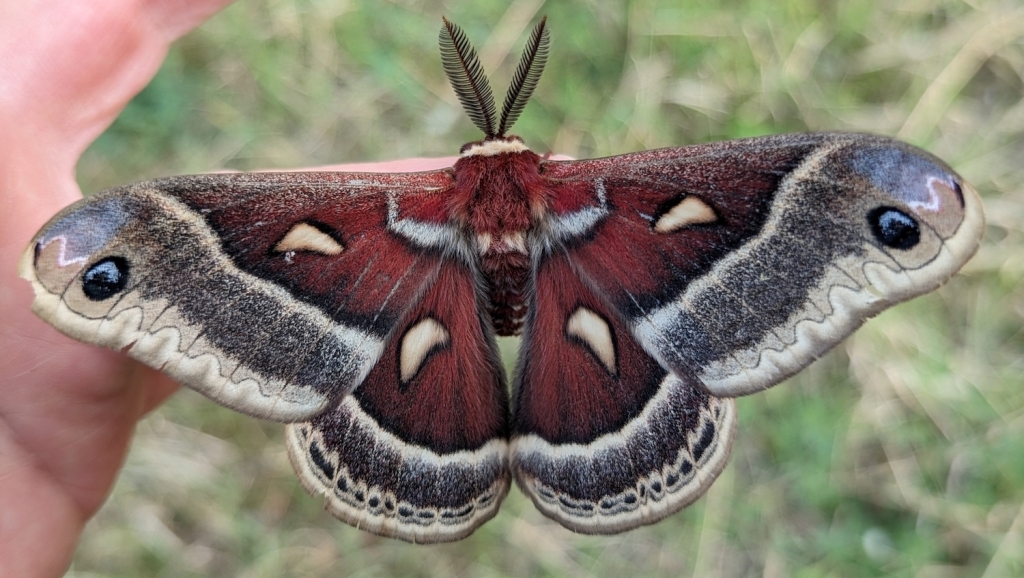
Let’s look at one of the more flamboyant families: the giant silk moths. There are ~2300 species globally but we have only 7 here in BC, found in two subfamilies, the Hemileucinae and Saturniinae. Our moths have a wing size of 60-140mm, but in the tropics some species get up to twice as large (280mm).
Most saturniids are nocturnal, but a few, including our Hemileuca species are diurnal. The larvae are frequently polyphagous1 and some have poisonous spines, such as, again, our Hemileuca’s.
Commercial silk is produced from a domesticated species, Bombyx mori, but other saturniids are also used.
Etymology
The family name is likely to have been derived from Saturn, the Roman god of agriculture. Many of the species in this family have circular concentric patterns on their wings, reminiscent of the rings of Saturn.
Alrighty! Let’s look at our species. So far I’ve only seen adults of the Saturniinae subfamily, but I’ll add photos for the others when I do.
Hemileucinae
- Coloradia pandora (Pandora pinemoth). At the time I write this, there are no iNat observations from BC but they’ve come up as far as Seattle so it’s hardly a stretch. This species has a single observation from Victoria. Neat-looking moth.
- Hemileuca eglanterina (Western sheep moth). Hemi=half; leuca=white, presumably refering to the different in colour of the fore- and hindwings. All the Hemileuca’s are quite attractive, this one especially. It’s day-flying, spotted from May-Sept. Wingspan up to 85mm. In BC the observations are centred in Victoria, and the lower half of the province with the exception of the lower mainland.
- Hemileuca nuttalli (Nuttall’s sheep moth). Listed as endangered by COSEWIC2; according to a 2015 paper this hasn’t been spotted in BC since 2002. They’re supposed to be found in the very southern end of the Okanagan from Oliver down to the border – wherever Antelope-brush (Purshia tridentata) is dominant.
- Hemileuca hera (Sagebrush sheep moth). Again found in the Okanagan, but a lot of observations have been recorded around Kamloops, May-Aug.
Saturniinae

- Antheraea polyphemus (Polyphemus moth). The largest silk moth in BC and one of the most common in the family.
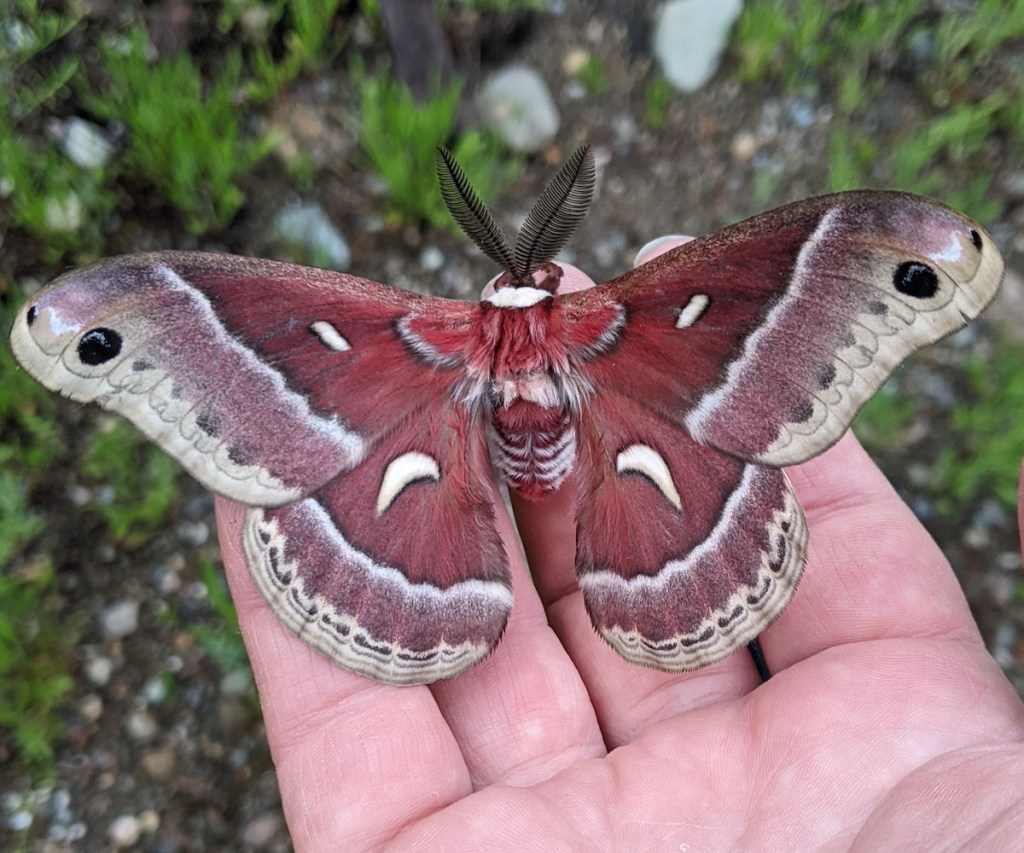
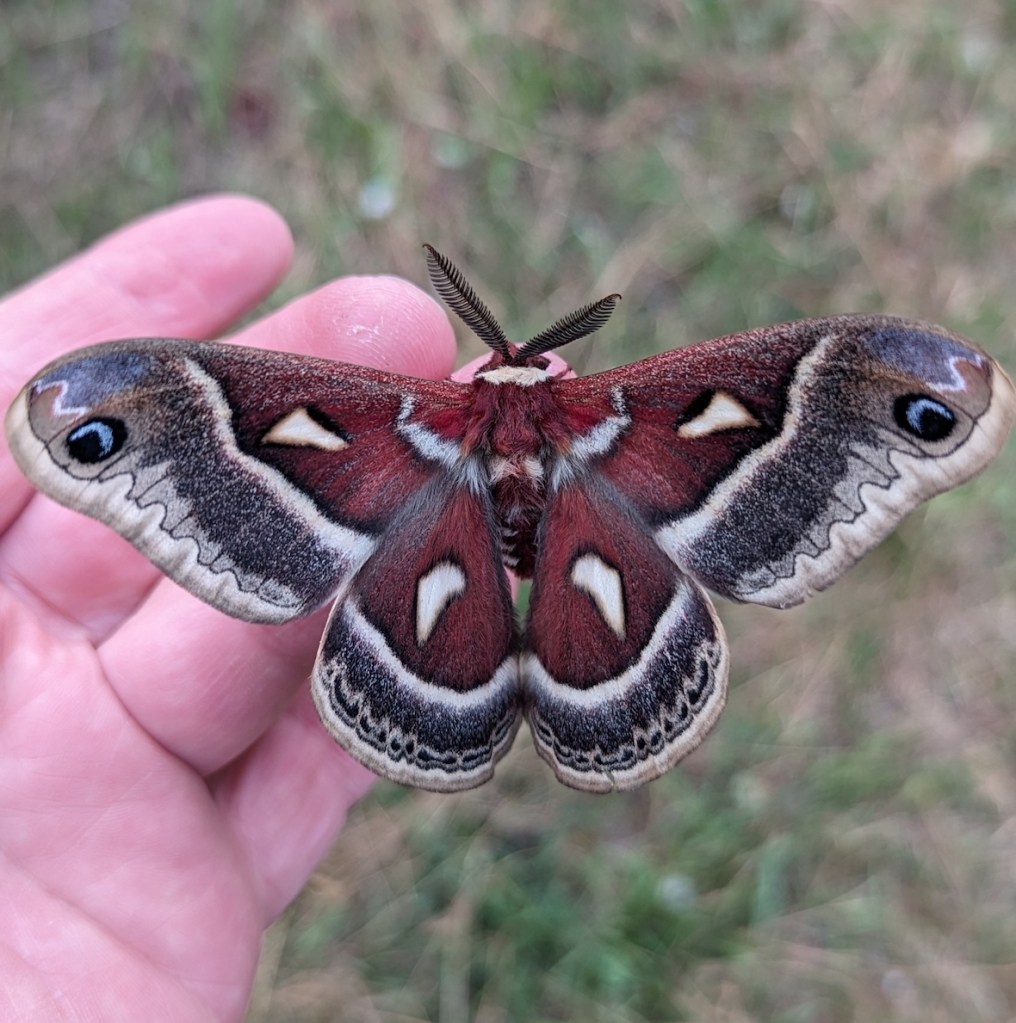
- Hyalophora euraylus (Ceanothus silk moth). Ceanothus is a genus in the Rhamnaceae (Buckthorn) family. The larvae feed on the plant, hence the name… mind you, they also feed on a ton of other plant and hey, the Hemileuca species also feed on Ceanothus. Anyway, extremely attractive, large moth. Strongly attracted to light, I get these in the moth nets every summer on Bowen Island. They seem to be late flyers – I typically don’t see them at the sheet until the early hours of the morning.
- Hyalophora gloveri (Glover’s silk moth). These are much rarer in BC than H. euraylus and only found in the Peace River region. They’re pretty similar as you can see from the images above, but darker overall – especially noticeable in the subterminal area. I saw a few on my trip to the Peace River region this year; I didn’t see any H. euraylis there at all.
Related: see a Hyalophora gloveri warm up its wing muscles in this post.
Post image: Hyalophora gloveri, Fort St John, May 19, 2023.
- Feed on various different types of food – a useful evolutionary advantage making them less dependent on a single source. ↩︎
- Committee on the Status of Endangered Wildlife in Canada. See: https://www.cosewic.ca ↩︎
 BC Moths