
One of the oddities in Lepidoptera-speak is the macro/micro distinction. As you’d expect from the name, micromoths are typically small and macromoths are typically big. But 10 seconds later you find out that there are some truly giant micromoths, which makes you wonder what numbskull chose the terms in the first place.
So what’s the deal? Well, it’s an artificial distinction: there’s nothing in the actual taxonomy that places them in these two pleasingly discrete, monophyletic1 buckets. The terms actually refer to how primitive they are. Micros are species that evolved from 250-200 Ma (million years ago – Mega-annum); macros are from 130 Ma.
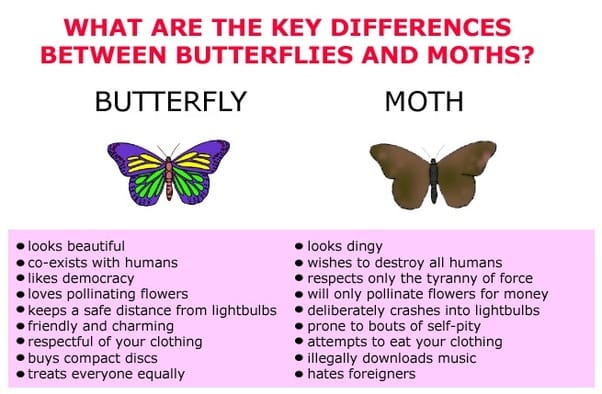
Alright, fine. But while we’re on the subject of baffling bifurcations, what’s with moth/butterfly? What’s the difference? It’s a perfectly reasonable question. Well don’t worry, this graphic has you covered:
(Found re-posted on internet – unknown source)
Meh! If only it was as clear as the diagram suggests. English happens to split the Lepidoptera into two camps but that doesn’t hold for all languages. In French they call them both papillons – with night-flying moths called the rather lovely papillons de nuit. Leps are a continuum: butterflies have certain common characteristics, but nothing that uniquely identifies them; they have no single attribute that some moths don’t also possess. Phylogenetically-speaking2, the butterfly families are actually grouped in the middle of the moth families, evolving around 130 Ma ago.
- Monophyletic: a group of organisms that evolved from a shared ancestor. ↩︎
- Phylogenetics is the study of evolutionary history of organisms and relationships between them. As such, taxonomy (the science of classifying things – organisms in particular) is fundamentally grounded in phylogeny: it attempts to group species close to their nearest relatives. ↩︎
 BC Moths